Money, Money, Money
Let's talk a little about money. Things have changed from when we used to travel with our U.S. Dollar. It used to be the boss when travelling to Italy and other European countries. Well, the past is the past. We Americans must travel smart and stretch our dollar. Here's how (in my opinion).I have traveled to Italy 5 times in the past 18 months and learned some expensive lessons.
Only bring enough dollars that you'll need when you return to the United States. There is no need to bring an excessive amount of cash. The worst thing you can do is bring your dollars to Italy (or any other European country) and exchange them for Euros. The rates are always excessive.
Credit cards (especially MasterCard) is the best way to pay overseas. If you need Euros in cash just go to the ATM. Your bank will charge you a small fee and give you the best exchange rate.
As far as our trip is concerned you should need very little cash with you, but if you feel the need just hit up the many ATMs on the Island. If you like, contact your financial institution and advise them that you will be traveling abroad.
Before you depart on your exciting tour of Italy, here are a few phrases and useful words to start you on your way.
Useful Expressions
English --- Italian --- Pronunciation
Good morning --- Buon giorno --- Bwown JOHR-no
Good evening --- Buona sera --- BWOW-nah SAY-rah
Good night --- Buona notte --- BWOW-nah NWOT-tay
Hello --- Ciao --- CHEOW
I"ll be seeing you --- Arrivederci --- ahr-ree-va-DARE-chee
My name is Mike --- Mi chiamo Mike --- Mee KYAH-mo Mike
Please --- Per favore --- pehr fah-vo-ray
Thank you --- Grazie --- GRAH-tsyay
How are you? --- Come sta? --- KO-may-stah?
You're welcome / at your service / after you --- Prego --- PRAY-go
Very well thanks. And you? --- Molto bene, grazie. E Lei? --- Mohl-toh BEY-nay, GRAH-tsyay. ay LEH-ee?
Walking Around/Help
English --- Italian --- Pronunciation
Where is the ticket office? --- Dov'e' la biglietteria? --- Dohv-AY la beel-yayt-tay-REE-ah?
Where is the train to Termini Station? --- Dov'e' il treno per Stazione Termini? --- Dohv-AY eel TRAY-noh pehr stah-TZYON-ay TEHR-mee-nee?
Excuse me, where are we? --- Mi scusi, dove siamo? --- Mee SKOO-zee, DOH-vay syam-o?
Please write it down. (If you can?t understand how much or what time.) --- Me lo scriva, per favore --- May loh SKREE-vah, pehr fah-VOHR-ay.
I speak a little Italian --- Parlo un po' d'italiano --- PAHR-lo oon po lee-tahl-yah-no
Let?s go dancing! --- Andiamo ballare! --- Ahn-DYA-moh bahl-LAH-ray!
Shopping
English --- Italian --- Pronunciation
One ticket for Milan, please --- Un biglietto per Milano, per favore --- Oon beel-LYAYT-toh per mee-LA-no, pehr fah-VOH-ray.
How much? How much does it cost? --- Quanto? Quanto costa? --- KWAHN-toh? KWAHN-toh KOHS-tah?
A coffee / cappuccino / beer, please --- Un caffe / cappuccino / una birra, per favore. --- Oon kahf-FAY / kappoo-CHEEN-oh / Oo-na BEER-rah, pehr fah-VOH-ray.
I?d like to buy a bottle of water, please --- Vorrei comprare una bottiglia di acqua minerale, per favore --- Vor-RAY com-PRA-ray oon-ah boht-TEEL-lya dee AHK-wah mee-nay-RAH-lay, pehr fah-VOH-ray
Tipping in Italy
This topic has always been much debated -- but people continue to weigh in on tipping versus not tipping.Should I tip or should I not? And how much money should I give? Usually the decision is based on how "helpful" the service was and the amount depends on the bill, better if it is not too expensive! The majority of tourists consider the tip an essential habit... well, the best advice is: "When In Rome, Do As the Romans Do" :-)
The word "mancia" (Italian for "tip") comes from the French "manche" (sleeve), which was the sleeve that the ladies gave the knight in chivalrous ceremonies. It is now an acknowledgment for the care received. With the tip one rewards those who have served with particular zeal and kindness, but of course none should feel obliged to do it if he/she was not treated well. The gesture must be discreet, veiled and does not have to force the waiter to reach out. At the restaurant a tip is left on the plate of the bill or directly to the cashier, who will be glad to tell the waiter about your "attention".
In most sit-down Italian restaurants, especially the nicer ones which have no counter service, you may find both "il coperto" and "servizio incluso" written on the menu. "Il coperto" is the cover charge, which is generally one or two Euro, and which takes care of things like bread before the meal and a glass of tap water. "Servizio incluso" means that service is included, meaning they’ve already figured in a tip for you – it’s usually around 15% – so the total due on your final bill is all you’ll owe. Most Italians do not tip in these cases, except when the service and quality are truly special. In bars, Italians often leave a few coins for a coffee or whatever.
If you’re paying cash, you can just round up to the next euro and call that your tip if you’d like. If the service has been particularly outstanding or you’ve had an exceptional experience, you can add 5% or 10% tip and put it on the table. It is also a lovely gesture to let the waiter know.
This same rule applies with taxi drivers (or private transfers) in Italy, too, by the way. A tip is not necessary and sometimes it’s not expected at all, but if you want to thank a driver for dealing with your heavy or plentiful luggage, or if you’ve had a nice chat, or whatever, you can just do a "keep the change" routine (in Italian, this is "tenga il resto") to not get the leftover coins back from your euro notes. Again If you feel you really want to leave something more, a 10% would be fine!
At the luggage porter: you can give 1.50 EUR per bag.
For tour guides it depends on the kind of service provided, but typical 5 - 10% is sufficient.
To the hairdresser: again tipping is not a must here. Of course it is always nice thing to do, but it's entirely up to you! In most cases we let them keep the change.
Walking from the Amalfi coast, Sorrento and Capri
by Julian Tippett, author of "Landscapes of Sorrento, Amalfi and Capri"
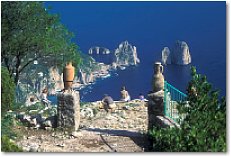 Unknown to most tourists, wonderful networks of footpaths criss-cross the peninsula and Capri, connecting little villages by easy paths and venturing on rougher ways up into the mountains. Visitors can plan simple walks of varying lengths often starting right outside their villa, allowing them to enjoy fantastic views whilst getting a feel for authentic Italy. The friendly local people you come across on foot could be pruning their vines, picking lemons or carrying supplies by mule to a remote house, a million miles from the tourist guide or souvenir vendor you meet in town. Experienced hikers can stretch their legs on stony trails high up in the mountains, guided by the red/white marks painted by the local Alpine Club (CAI), followed by a cool beer in a village bar at the end of the day.
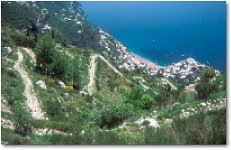 Along the Amalfi coast the terrain is very steep, the bonus being spectacular views around every corner, but with the effect that paths are often built as stone steps. It helps to take your time to avoid getting out of breath or maybe take a bus to a higher starting point and walk mainly downhill. Mind you, going down a lot of steps can be hard on the knees too. If you are at all worried by this warning, just start with modest plans to get a feel for how the paths play out for you; judging by my fan mail few people are much bothered. At the Sorrento end of the peninsula and on Capri you'll meet fewer steps as the terrain is mostly more forgiving there.
 How do you get onto the paths?
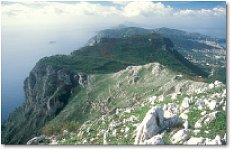 An obvious answer is to buy my guidebook "Landscapes of Sorrento, Amalfi and Capri" which gives detailed directions to footpaths on the whole of the coastline west from Maiori, including Ravello, Amalfi, Praiano, Positano and all of the peninsula behind Sorrento. It offers a number of routes on Capri. The network is divided up into 72 "segments", with instructions given for how to walk each segment in either direction. Walk planner maps help you put together a walk of just the length you want by selecting and combining these segments to form a specific route. You can take account of where the bus will drop you and how much climbing each segment demands. Illustrated in colour, general sections of the guidebook contain lots of practical information useful to walkers including how to use the public transport (with timetables). Motorists can sample some mini car tours helped by a touring map to get you to some interesting out-of-the way places.
Maps
Three maps obtained locally are detailed enough for walkers.Map 1. "Monti Lattari" at a scale of 1:30,000, published by CAI, covers the whole peninsula and Capri, and shows trails high in the mountains not described in my guide. You have to be quite a good map reader to use this as, although the contours and rock markings are very accurate, that can't be said of the footpath symbols which are quite out of date. Even the CAI routes, marked in red, waver off course in quite a few places, but they do show where to look for a route. The map contains no grid usable for GPS position finding.
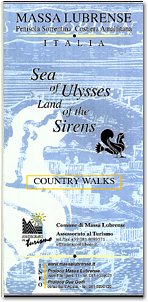 Map 2. Covering the peninsula behind Sorrento, including Sant'Agata, Massa Lubrense and Punta Campanella, the footpaths on this map are much more precisely marked. Entitled "Sea of Ulysses and Land of Sirens - Country Walks" it is issued free of charge from the tourist offices of the three main towns just mentioned. Colour-coded walks cover the whole area, these colours being visible on the paths themselves as painted waymarks, with ceramic plates set into the paving at junctions to give more directions. The complete set-up is quite a tour de force. If you are a bit uncertain with maps you may still prefer my guidebook, but others will find the map enough on its own in this area.
Map 3 is also issued free of charge, from the Ravello tourist office. Look for "Passeggiate - Walks" which shows accurately the paths around Ravello and down to Amalfi in great detail.
Getting to a Walk - car or bus?
Having a car is a mixed blessing. If your villa lies away from bus services a car will get you to your walk easily, but everywhere along the Amalfi coast road from Positano to Maiori and in Sorrento you'll find parking a nightmare. Parking in the little villages in the hills away from the coast road is easier. Two tips for car users:1. On a circular walk, start and end the walk in a small village en-route where the parking will be easier, e.g. you want to go from Amalfi to Ravello up one way and back down another, so park in Pontone or Scala which lie on one of the routes.
2. Consider using a bus to get to the start, or back to the car at the end, e.g. park at Pogerola above Amalfi if you want to walk to San Lazzaro, followed by the Via dei Villaggi path back down to Amalfi. You'll be tired by the time you get there, so take the bus back up to your car (hourly service approx).
If you can get to Amalfi or to Sorrento easily from your villa, or a number of other more minor centres like Ravello or Sant'Agata, you will not need a car for your walking; use the bus services that radiate from those places to connect to the start or end of your walk. Or work out a walk parallel to the coast road and return by bus along it. Once you are on the bus routes, then walk planning becomes easy. My guide book gives the detail of bus routes, how to use them, and times. For up-to-date timetables, look at http://www.sitabus.it/wps/portal/OrariCampania. Quadro nos. 13, 14 and 15 cover our area. Timetables change for the summer season which runs Easter to the end of October.
